




Nanobubbles
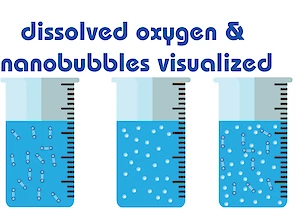
Visualization of invisible nanobubbles in water.

The easiest way to visualize nanobubbles is via a Green Laser beam. The ones you use for a PowerPoint presentation, or some people have them to play with their cats.
Acniti recommends using a Green Laser beam, with a light spectrum of 532 nm and a power usage of 150 mW.

Links
Ozone nanobubbles are attractive for water purification, treatment, and disinfection. ozone nanobubbles have a higher mass transfer rate than ordinary bubbles and there for nanobubbles more efficiently use ozone as a powerful oxidizing agent and sterilizer to kill or inactivate bacteria and viruses.
Concrete is the main part of building materials and it is almost impossible to replace concrete with other natural resources. According to several scientific articles, the application of nanobubbles improved the compressive and tensile strength of concrete. on the other hand, mixture of zeolite, Chekneh pozzolan, and nanobubbles water significantly improve the strength and durability of the concrete, which is a meaningful alternative to cement and mixing water to reduce air pollution, increase concrete performance, and reduce concrete production costs. Nanobubbles technology is the best, cheapest, simplest and safest way to improve the mechanical feature of constructional materials.
Chlorine-heavy pools cause skin irritation, red eyes, and persistent chemical odors. Nanobubble technology injects billions of microscopic oxygen bubbles that oxidize contaminants naturally, reducing chemical dependency. The result: crystal-clear, odor-free water with far less maintenance.
Nanobubbles can be measured by the same technology as measuring small particles. You can measure bubbles by camera (count pixel size) or laser (count blackout time), also as a simple method to know number index, you can refer information of turbidity. When you measure UFB, most common way is to analyze Brownian Motion.
Explore Henry's law in acniti nanobubble technology: learn how gas solubility, pressure and supersaturation influence micro and nanobubble generation.
Oxygen plays an important role in plant respiration, which causes energy production and plant growth. Increasing the percentage of oxygen in water improves the root structure and the activity of useful microbes in the rhizosphere. Naturally, an effective and practical system can increase productivity by improving the quality of irrigation water and increasing dissolved oxygen in irrigation water. Acniti oxygen concentrator and Acniti turbiti O3 are very effective supplements for irrigation of agricultural fields and at the same time improve water quality and increase dissolved oxygen (DO) and ozone in irrigation water. To determine the role of oxygen and ozone nanobubbles in the growth of lettuce, an experimental research was conducted. Research showed that by using Acniti nanobubbles generators, will increase the level of dissolved oxygen in water, and makes the roots of lettuce grow more and its weight increases significantly.
A technical exploration of the physics behind oxygen nanobubbles, detailing the Young-Laplace equation, ultrafine bubble internal pressure effects, and mass transfer coefficients. Ideal for engineers and scientists looking to optimize oxygenation in water treatment, aquaculture, and hydroponics.
Chlorine odors, algae, and rising chemical costs are the problems Swim Puriti O3 is built to solve. This pool nanobubble generator delivers ozone-enriched ultrafine bubbles directly into your return line, combining powerful oxidation with nanobubble persistence for crystal-clear, low-chemical water. Available in seven sizes from 75 to 600 LPM for residential, spa, and commercial pools.
Discover how Nitrogen nanobubble technology from Acniti revolutionizes chiller maintenance, dramatically reducing corrosion, biofilm, and scaling issues for reliable, efficient cooling. Learn about proven results, easy retrofitting, sustainable water treatment, and why nanobubbles offer both cost and regulatory advantages for facilities. Read the full article for practical implementation and insights from real-world sites.
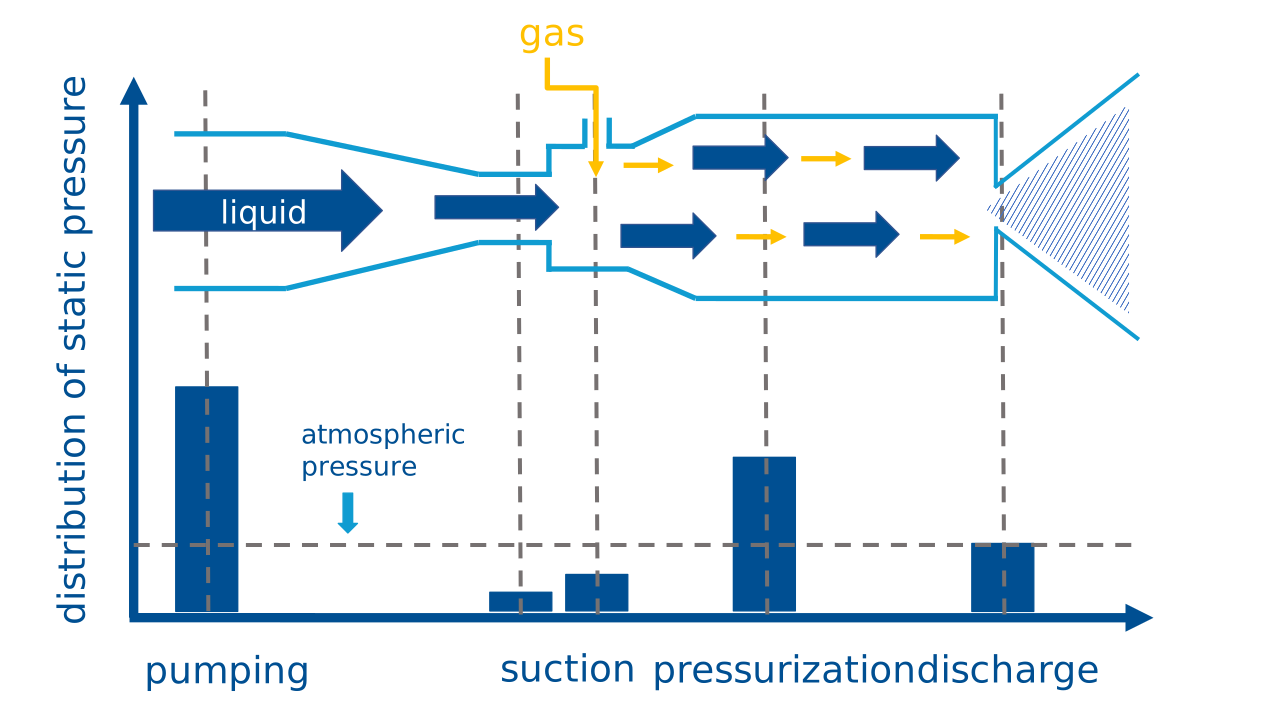
There are various technologies to generate nanobubbles (ultrafine bubbles). This article gives an overview of the most used techniques, such as pressurized dissolution, static mixers, and rotational flow.
Water is one of the fundamental components of life. A large part of living cells is made up of water. Birds need twice as much water as the food they eat. To satisfy the need for water in poultry and birds, you must make water freely available to them. Note that the unavailability and limitation of water consumed by poultry slows down their growth. The water used in poultry feeding should not contain parasites, bacteria, pollution or chemicals, and fresh and clean drinking water must be provided. Bacterial agents are one of the most common water-borne infections. Drinking contaminated and untreated water can cause huge losses in the poultry industry. Using chemicals and antibiotics to disinfect drinking water can cause health problems and drug resistance in chickens. In the last decade, researchers have tried to find a suitable alternative to disinfect and improve the quality of drinking water for farm animals, especially chickens. One of the most available and best options is oxygen-nanobubbles water. By providing oxygen- nanobubbles water, the growth and development of chickens increases, and on the other hand, it enhances their resistance against microbial infections. In this article, we evaluate the benefits of oxygen-nanobubbles water in the poultry industry.
Washing of surfaces and laundry is one of the promising areas were nanobubbles can make a difference in the application. Reducing the amount of detergent, has a positive effect by reducing pollution, washing laundry without detergent, would greatly benefit the environment. Nanobubbles can lower the surface tension of water, the large amounts of oxygen molecules in bubbles charge the water negative.
Interested to know why nanobubbles are officially called ultrafine bubbles? In this article we explain the reasons why the ISO technical committee has decided to use the official name ultrafine bubbles instead of nanobubbles.
Explore zeta potential's role in nanobubble stability and surface charge dynamics. Learn how this key parameter affects gas transfer efficiency and applications
Unlock crystal-clear water in your pool with acniti's step-by-step guide for calculating nanobubble generator size. Learn expert techniques to optimize water clarity, efficiency, and health benefits, ensuring a superior swimming experience with innovative technology.
Acniti partner Foreport in Taiwan conducted a vegetables young plant cultivation trial, irrigating with oxygen nanobubbles. The nanobubble irrigation water had a DO of 20 ppm versus the regular irrigation water which had 6.8 ppm. After 6 weeks results were taken it was concluded that the crop treated with nanobubbles was 25-30% heavier. The nanobubble irrigated crop also had a better developed root system which will lead to less root diseases and better survival rates during hot summers.
Learn how the Complutense University of Madrid uses Acniti nanobubble technology to increase wastewater treatment efficiency and remove emerging contaminants. The research highlights that this technology enhances plants without requiring major infrastructure investments—a significant pain point for municipality and industrial plant managers.
Choosing the wrong benchtop nanobubble generator derails experimental reproducibility. Gas chemistry, shear profile, and thermal budget all determine whether miniGaLF, Turbiti Fusion, or microStar fits your protocol. This guide breaks down all three systems so your hardware matches your science, not the other way around.
Explore groundbreaking research on air nanobubbles and their revolutionary impact on oxygen transfer in wastewater treatment systems. This comprehensive study reveals how nanobubble technology achieves six times faster dissolved oxygen increases compared to conventional aeration methods, offering significant energy savings and enhanced treatment efficiency. Learn about the experimental results using Acniti's Microstar Nanobubble Generator, which demonstrates improved oxygen mass transfer coefficients and optimal bubble size distribution.
Efficient nanobubble generators from Acniti for water treatment, agriculture, aquaculture, and research. Improve dissolved gas levels and water quality
Pool water problems - excess chemicals, chloramine odors, cloudy water - are exactly what Swim Puriti O2 is built to solve. This pool nanobubble generator infuses oxygen-rich ultrafine bubbles into your return line, reducing chemical use by 50-100% while delivering softer, clearer water. Available in three sizes from 75 to 600 LPM for residential, spa, and commercial pools.
Not all bubbles behave the same. Milli, micro, and nanobubbles each have distinct physical properties that determine how gas transfers in water, how long bubbles persist, and how useful they are in real applications. This guide breaks down bubble size categories, surface area physics, zeta potential, and gas pressure - so you can choose the right bubble technology for your process.
The Turbiti Fusion is a plug-and-play micro nanobubble generator using a turbulent mixer-ejector principle to produce billions of ultrafine bubbles per minute. With flow rates of 540–900 L/h and compatibility with O₂, air, CO₂, N₂ and ozone, it delivers superior dissolved oxygen levels for water treatment, aquaculture, and biochemical processes. Available in 115V and 230V configurations.
Efficient static mixer for nanobubbles. Treats large water volumes, low energy use, clog-resistant. Ideal for agriculture, livestock, and aquaculture.
The miniGaLF Plus is a lab-scale nanobubble generator designed for high-concentration research. By implementing a recirculation loop, this pressurized dissolution system achieves densities exceeding 100 million ultrafine bubbles per ml. Compatible with non-corrosive gases including O2, N2, and CO2, it features an easy-to-retrofit design for universities and industrial R&D. Ideal for precision gas-liquid mixing and zeta potential studies.
Nanobubbles movie, movie made with the Malvern NanoSight. Based on this movie the NanoSight internal software counts the number of bubbles to calculate the number concentration of bubbles and the bubble size.
Visualization of invisible nanobubbles in water via Green Laser 150nW 532nm
Discover the ultrafine GaLF, a cutting-edge generator delivering the highest concentration of nanobubbles in the Finebubble industry. Designed for researchers, universities, and labs, it’s perfect for fundamental research and product development. With advanced PLC controls and flexible gas options, this compact and robust unit ensures peak performance and easy operation. Read more to see how nanobubbles can boost cleaning, plant growth, and fish health.
Selecting a nanobubble generator can be a daunting task when you are new to the technology. In the following article we explain the differences of the various units. This helps you to select the best nanobubble generator for your research, application development or ultrafine bubble production.
The electrical properties of gas bubbles are important in determining the interaction of nano-bubbles if and when they merge together and how they interact with other materials such as solid particles or oil droplets. Knowledge about this helps application development in for example, protein skimmers, froth flotation, food processing, washing surfaces and purification.
Ozone is one of the most powerful disinfectants available, but getting it into water efficiently is the challenge. Turbiti Ozone nanobubble mixers use proprietary swirl flow technology to dissolve ozone as ~100 nm bubbles, extending ozone residual and improving treatment performance across a range of water volumes and applications.
Traditional nanobubble generators rely on pumps and pressure, which wastes energy and stirs up water. The microStar uses patented hammermill rotation - a shaft spinning at 3,400 RPM crushes ozone gas into high-concentration nanobubbles with zero turbulence. Available in three sizes, from lab research to industrial disinfection and seawater treatment.
Stagnant water in urban ponds and moats triggers seasonal algal blooms that cause fish mortality, foul odor, and murky water. Acniti solved these problems at Kyoto's 810m Higashi Honganji temple moat using submersible nanobubble aerators paired with a natural probiotics program, raising dissolved oxygen from 4.5 to 9 ppm and clearing the water completely within three months.
Carnation flower growers in Japan use nanobubble irrigation technology against fusarium, withering and dying plants, to improve stem quality, flower size, shoot count, volume of stems and growth speed. In the growing season 2017 / 2018, acniti conducted trials, the test area had irrigation water with billions of ultrafine bubbles of an average size of 110 nm and high DO water with 30 mg/l.
poultry nanobubbles solutions
chicken
Acniti is a Japanese manufacturer specializing in nanobubble equipment and industrial oxygen concentrators. Based in Osaka since 2017, we are the only provider offering three distinct nanobubble generation technologies: pressurized dissolution, turbulent static mixer, and hammer-mill rotation. Our solutions serve universities, water treatment, aquaculture, agriculture, mining, wastewater remediation, and industrial cleaning applications globally. Acniti products integrate robust PSA oxygen concentrators with proprietary nanobubble generators for 24/7 industrial operation. Acniti does not supply oxygen concentrators for medical purposes.
Low DO levels in deep reservoirs and ponds stall aquaculture yields and rot root zones in horticulture systems. The Turbiti submersible nanobubble mixer solves this by operating entirely underwater, injecting 100-200nm bubbles directly into the water column for maximum oxygen transfer efficiency. Built from 316L stainless steel, it installs without a pump house and runs on 115 or 230V.
The Turbiti is a turbulent mixer nanobubble generator built for industrial water treatment, aquaculture, and horticulture. Proprietary swirl flow technology generates nanobubbles with no moving parts and minimal maintenance. The stainless steel housing, built-in one-way gas valve, and particle tolerance up to 2 mm make it a reliable fit for both fresh and saltwater applications, from greenhouse crops to shrimp and salmon cultivation.
The GaLF-CIP is a custom-built ultrafine nanobubble generator for the food and beverage industry. It produces hydrogen or oxygen nanobubble drinking water — and is also compatible with ozone, CO₂ and nitrogen. Installed at bottling facilities across Japan with a capacity up to 4,000 L/hr. Built with Clean-In-Place (CIP) certified sanitary fittings to meet international certification requirements. Specify your requirements and we build to order.ao
Overview of ultrasonic nanobubble generation, techniques, and eco-friendly cleaning benefits.
Nanobubbles generation technology pressurized dissolution method
Probiotics water treatment with nanobubbles and powerful micro-organisms and bacteria. Efficient micro-organisms working in combination with ultra-fine bubbles
Discover how three Japanese flower growers revolutionized their cultivation with Acniti's turbiti nanobubble technology. Learn about improved root development during hot summer planting seasons and increased winter harvests that deliver payback in just 1-2 seasons.
Benefits for the combination of nanobubbles and probiotics Aquaculture
Magnetic Hammermill Rotation: Ultra-Low Energy Nanobubble Generation at 3400 RPM
ISO TC281 sets standards for ultrafine bubbles, improving water oxygenation and boosting plant growth with Acniti technology.
The Oxiti Aerator 100 is a high-capacity industrial air pump designed to feed nanobubble generators in deep-water installations. It delivers 40-100 LPM of clean air at depths up to 6 meters, enabling continuous oxygen dissolution and nanobubble generation. Oil-free and maintenance-free for up to 15,000 hours, it's built for continuous aquaculture, water treatment, and aeration operations.
Standard venturi injection lets ozone off-gas before it can work. The Turbiti O3 Mount combines venturi injection with turbulent nanobubble mixing to keep ozone dissolved far longer. No pump or external power needed - just connect water in, out, and ozone gas. Available in models 828 and 838, covering 75-400 LPM for greenhouse disinfection, livestock drinking water, and industrial wastewater ozonation.
The blenderGaLF delivers the same high-concentration ultrafine bubble performance as the GaLF series, with one key difference - your control system runs the process. No PLC, no factory settings. Built from SUS304 or SUS316 stainless steel, compatible with ozone, hydrogen, and all process gases. Available in 17, 100, and 200 LPM.