





Water pump
Water pump

Links
The miniGaLF Plus is a lab-scale nanobubble generator designed for high-concentration research. By implementing a recirculation loop, this pressurized dissolution system achieves densities exceeding 100 million ultrafine bubbles per ml. Compatible with non-corrosive gases including O2, N2, and CO2, it features an easy-to-retrofit design for universities and industrial R&D. Ideal for precision gas-liquid mixing and zeta potential studies.
Water treatment Tsurumi Pump 50 PN2.75 for turbiti nanobubble mixer 737 in a submersible configuration.
The Turbiti pump skid is a complete, ready-to-install nanobubble generator that combines a pump and Turbiti mixer in a single unit. Available with multiple pump configurations including stainless steel options for agriculture and aquaculture, and corrosion-resistant models for saltwater. Designed for easy integration into existing systems.
Tsurumi Pump 50TM.275 for turbiti nanobubble mixer 737 in a submersible saltwater configuration.
Smart self-cleaning inlet filter prevents pump blockage and reduces maintenance by automatically backwashing debris, ideal for clean and dirty water
The ALT-9F17 is a laser-based nanobubble sensor validated for real-time ultrafine bubble monitoring at a fraction of NanoSight lab costs. With a 0.992 correlation against the NS500, it's a proven NanoSight alternative for industrial process control, automated nanobubble concentration measurement, and energy optimization - bringing accurate ultrafine bubble monitoring out of the lab and into production.
Acniti offers two sensor sample pumps for ozone water concentration sensors and the ALT nanobubble monitoring system. Choose the corrosion-resistant model (SUS304, PTFE, FKM) for harsh ozone environments, or the standard model (EPDM, brass) for general water monitoring. Both run on 100-230V at 15W and handle water temperatures from 0-60°C.
The RF200 to RF400 series are self-cleaning pump inlet filters for surface-mounted pumps, handling 220-1000 LPM with mesh options from 50 micron to 6 mm. A patented backwash rotor powered by filtered pump output keeps the screen clear continuously - no manual cleaning required. SUS316 cage construction throughout.
pump option for miniGaLF the Lowara PM21.miniGaLF Plus option use the pump to create a higher concentration of nanobubbles
The DC diaphragm sample pump delivers a continuous, stable water supply to the ALT 9F17 nanobubble sensor for uninterrupted monitoring. Operating at 0.3 L/min with a compact φ27 × 61.8 mm body and universal 100–230 V power input, it connects directly to the ALT via 6 mm ports. An optional micro-bubble removal filter can be installed between pump and sensor for enhanced accuracy.
Water is one of the fundamental components of life. A large part of living cells is made up of water. Birds need twice as much water as the food they eat. To satisfy the need for water in poultry and birds, you must make water freely available to them. Note that the unavailability and limitation of water consumed by poultry slows down their growth. The water used in poultry feeding should not contain parasites, bacteria, pollution or chemicals, and fresh and clean drinking water must be provided. Bacterial agents are one of the most common water-borne infections. Drinking contaminated and untreated water can cause huge losses in the poultry industry. Using chemicals and antibiotics to disinfect drinking water can cause health problems and drug resistance in chickens. In the last decade, researchers have tried to find a suitable alternative to disinfect and improve the quality of drinking water for farm animals, especially chickens. One of the most available and best options is oxygen-nanobubbles water. By providing oxygen- nanobubbles water, the growth and development of chickens increases, and on the other hand, it enhances their resistance against microbial infections. In this article, we evaluate the benefits of oxygen-nanobubbles water in the poultry industry.
poultry nanobubbles solutions
chicken
Ebara pump option for the turbiti nanobubble ozone mixer 3LM4 40-160/0.55
Selecting a nanobubble generator can be a daunting task when you are new to the technology. In the following article we explain the differences of the various units. This helps you to select the best nanobubble generator for your research, application development or ultrafine bubble production.
Ebara DWO 400 for nanobubble generator turbiti 737 and small 747 applications
The suction pump O3 decomposer draws ozone-laden air or gas through a catalytic destructor at 10 or 25 LPM, breaking down residual O3 before exhaust. Runs on 110 or 220V with a 6mm quick-connect fitting. Designed for use with acniti ozone destruction systems in aquaculture, water treatment, and industrial ozone installations.
The Acniti ozone destructor safely eliminates residual ozone after treatment processes in water and air applications. Using a manganese-palladium catalyst, it converts excess O3 to pure oxygen with minimal maintenance. The modular design scales from small lab setups to large ozone contact tanks - ideal for ozone system operators who need a reliable, low-hassle off-gas solution.
Ensure optimum performance of your ultrafine bubble generator with the ALT-9F17—an advanced nanobubble sensor that provides accurate, real-time monitoring using the scattered laser method. Discover how this compact and user-friendly solution helps you control water quality, reduce costs, and enhance operational efficiency. Explore its key specifications, features, and application benefits to unlock superior water management.
Ebara JESX 5, 6 or 8 pump is suitable for turbiti 707 and miniGaLF nanobubble generators
The small pump inlet filter series offers self-cleaning filtration at 30, 60, and 90 LPM. Three configurations - single, duplex, and triplex - share the same backwash rotor technology. Suitable for pond pumps, irrigation, aquaculture sample lines, and industrial process filtration. Choose mesh sizes of 60, 115, or 250 μm.
Grundfos CM1-4 pump is suitable for turbiti 707 and miniGaLF nanobubble generators
Pump option for miniGaLF and turbiti 707 the Ebara PRA 0.50, pump is part of the miniGaLF Plus option use the pump to create a higher concentration of nanobubbles
Ebara 3M 50-125/3.0 for nanobubble generator turbiti 747 and 848
The RF600 series are industrial self-cleaning intake strainers for large pump suction lines, handling 1,500 to 4,600 LPM. An internal backwash rotor uses a fraction of pump output to continuously clear the stainless steel mesh - no manual cleaning, no settlement tanks. Available in SUS304 and SUS316 with mesh apertures from 315 μm to 6 mm.
Recommended pump for the turbiti 737 land based or ozone systems Grundfos CM10-1
Self-cleaning filters prevent pumps from blocking and make aeration more efficient. These pump are also excellent as dewatering filters for drainage of tanks or flooded areas. This video explains the inner-workings of this smart water-filter.
The EL-550 is a compact ozone water sensor combining detection and processing in a single all-in-one housing. Using UV absorption technology, it measures dissolved ozone from 0-50 mg/L (default) with ranges up to 150 mg/L available. This cost-effective monitor features analog outputs (0-1V, 0-10V, or 4-20mA), digital display with rotary selection, and operates from 5-40°C water temperature. Ideal for industrial water treatment, research laboratories, and aquaculture applications requiring reliable ozone monitoring.
Choosing the wrong benchtop nanobubble generator derails experimental reproducibility. Gas chemistry, shear profile, and thermal budget all determine whether miniGaLF, Turbiti Fusion, or microStar fits your protocol. This guide breaks down all three systems so your hardware matches your science, not the other way around.
The Turbiti 737 Sub is a submersible nanobubble generator that dissolves oxygen or air directly in the water column using turbulent mixing technology. Designed for aquaculture, water treatment, and aeration applications, it operates at 230V and connects via a 25 mm outlet with a 10 mm gas inlet.
The Turbiti 737 Sub is a submersible nanobubble generator that dissolves oxygen or air directly in the water column using pressurized dissolution technology. Designed for aquaculture, water treatment, and aeration applications, it operates at 115V and connects via a 1-inch outlet with a 3/8" gas inlet.
The Turbiti is a turbulent mixer nanobubble generator built for industrial water treatment, aquaculture, and horticulture. Proprietary swirl flow technology generates nanobubbles with no moving parts and minimal maintenance. The stainless steel housing, built-in one-way gas valve, and particle tolerance up to 2 mm make it a reliable fit for both fresh and saltwater applications, from greenhouse crops to shrimp and salmon cultivation.
Acniti offers dissolved oxygen controllers and handheld monitors designed for nanobubble generators and oxygen generators. The DO controller automates aeration using PLC-based setpoint control, while the Polaris handheld sensor provides portable DO measurement with NFC and Bluetooth. Both target aquaculture, shrimp farming, and high-DO water treatment applications.
The Turbiti Fusion is a plug-and-play micro nanobubble generator using a turbulent mixer-ejector principle to produce billions of ultrafine bubbles per minute. With flow rates of 540–900 L/h and compatibility with O₂, air, CO₂, N₂ and ozone, it delivers superior dissolved oxygen levels for water treatment, aquaculture, and biochemical processes. Available in 115V and 230V configurations.
The corrosion-resistant sensor sample pump is a precision diaphragm pump designed to deliver water samples to ozone and nanobubble sensors without contamination or material degradation. With SUS304, FKM, and PTFE wetted parts and a wide 100-230V power range, it fits industrial and lab monitoring setups worldwide.
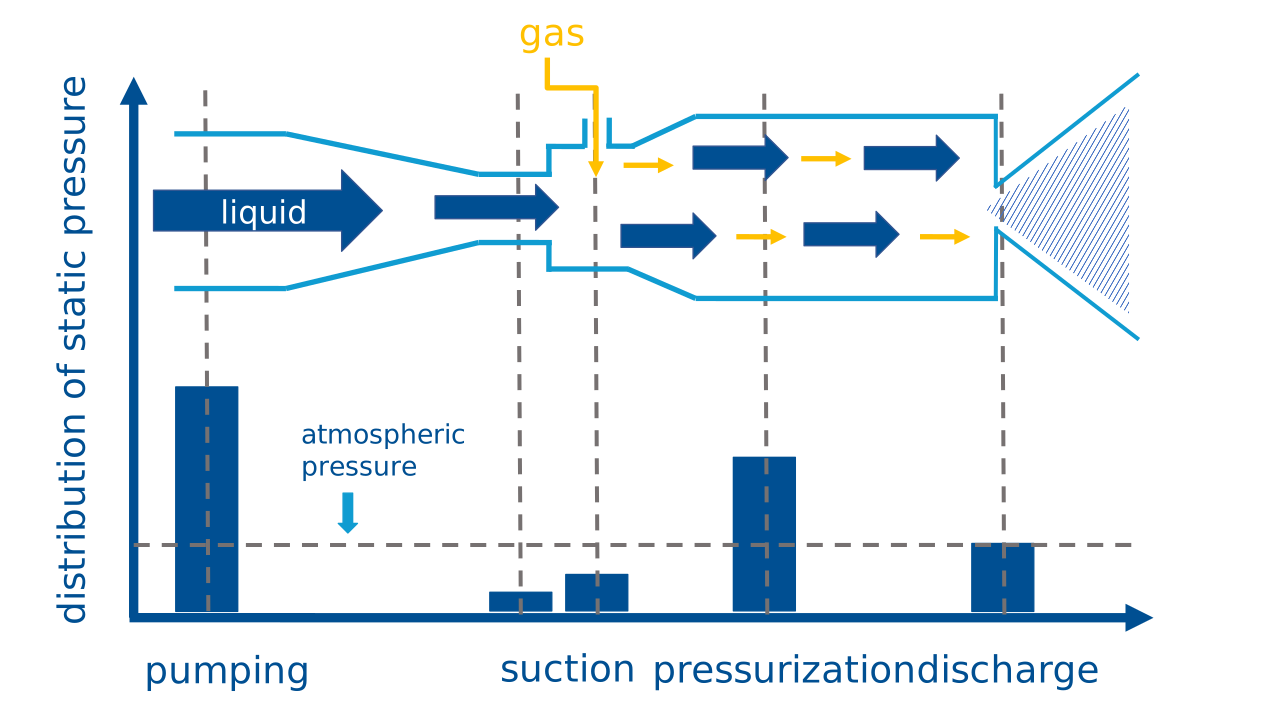
There are various technologies to generate nanobubbles (ultrafine bubbles). This article gives an overview of the most used techniques, such as pressurized dissolution, static mixers, and rotational flow.
Pump for turbiti nanobubble generator Grundfos CM3-5
The blenderGaLF delivers the same high-concentration ultrafine bubble performance as the GaLF series, with one key difference - your control system runs the process. No PLC, no factory settings. Built from SUS304 or SUS316 stainless steel, compatible with ozone, hydrogen, and all process gases. Available in 17, 100, and 200 LPM.
The miniGaLF is Acniti's entry-level GaLF nanobubble generator, made for universities, research institutes, and companies working with ultrafine bubble technology. Pressurized dissolution drives air, oxygen, nitrogen, or CO2 into water at 450 liters per hour. Connect it to a tap and a gas source and you are running in minutes, or add the -Plus pump option to recirculate and reach higher bubble concentrations.
The Oxiti Aerator 100 is a high-capacity industrial air pump designed to feed nanobubble generators in deep-water installations. It delivers 40-100 LPM of clean air at depths up to 6 meters, enabling continuous oxygen dissolution and nanobubble generation. Oil-free and maintenance-free for up to 15,000 hours, it's built for continuous aquaculture, water treatment, and aeration operations.
Acniti offers three industrial ozone water sensors for precise measurement of dissolved ozone from 0-50 mg/L. The EL-550 provides compact UV absorption monitoring in an all-in-one housing. The EL-610 features advanced microprocessor control with separated sensor and controller. The portable CX-100 II delivers economical field measurement for calibration and on-site testing. All models serve water treatment facilities, research laboratories, and aquaculture operations.
Pump for turbiti 727 nanobubble generator Grundfos CM5-3
The Turbiti 727 is a compact pump skid nanobubble generator built for continuous flow applications at 32-130 LPM. Using a turbulent mixer ejector, it dissolves oxygen, air, CO2, or N2 into water without corrosive gas restrictions. Ideal for water treatment, aquaculture, and agriculture installations requiring a reliable, self-contained nanobubble system.
The Turbiti 747 is a fully integrated nanobubble generator pump skid built for high-volume water treatment at 400 to 600 LPM. Powered by a 3kW Ebara centrifugal pump at 230V, it uses turbulent mixer-ejector technology to dissolve oxygen, air, CO2, or N2 into water. Designed for industrial and aquaculture applications where consistent gas transfer at scale is critical.
The Turbiti 636 is a ready-to-install nanobubble generator pump skid handling 83-220 LPM of water. Built on turbulent mixer-ejector technology, it dissolves gases into water at high efficiency. Wetted parts in glass fiber reinforced Noryl make it suitable for saltwater and seawater applications.
The Turbiti 737 is a fully integrated nanobubble generator pump skid built for continuous flows of 200-300 L/min. Using turbulent mixer ejector technology, it dissolves gases directly into the water stream. Designed for industrial water treatment, aquaculture, and agriculture at 230V/3-phase.
microbubble pump for turbiti 707, 808, 909 and miniGaLF
Turbiti 747 O2 wall mounted nanobubble mixer specs. Ultrafine bubble generator spec sheet
Turbiti 737 O2 wall mounted nanobubble mixer specs. Ultrafine bubble generator spec sheet
Turbiti 727 O2 wall mounted nanobubble mixer specs. Ultrafine bubble generator spec sheet