




Carbon dioxide
Links
Nanobubbles Carbon dioxide Feed systems to saturate wine, liquids, beverages, swimming pools, water with CO2
A new innovative way to transport fish while sleeping is almost ready to go onto the market. A combination of CO2 and ultrafine bubbles make this possible.
Concrete is the main part of building materials and it is almost impossible to replace concrete with other natural resources. According to several scientific articles, the application of nanobubbles improved the compressive and tensile strength of concrete. on the other hand, mixture of zeolite, Chekneh pozzolan, and nanobubbles water significantly improve the strength and durability of the concrete, which is a meaningful alternative to cement and mixing water to reduce air pollution, increase concrete performance, and reduce concrete production costs. Nanobubbles technology is the best, cheapest, simplest and safest way to improve the mechanical feature of constructional materials.
Choosing the wrong benchtop nanobubble generator derails experimental reproducibility. Gas chemistry, shear profile, and thermal budget all determine whether miniGaLF, Turbiti Fusion, or microStar fits your protocol. This guide breaks down all three systems so your hardware matches your science, not the other way around.
Discover the ultrafine GaLF, a cutting-edge generator delivering the highest concentration of nanobubbles in the Finebubble industry. Designed for researchers, universities, and labs, it’s perfect for fundamental research and product development. With advanced PLC controls and flexible gas options, this compact and robust unit ensures peak performance and easy operation. Read more to see how nanobubbles can boost cleaning, plant growth, and fish health.
Selecting a nanobubble generator can be a daunting task when you are new to the technology. In the following article we explain the differences of the various units. This helps you to select the best nanobubble generator for your research, application development or ultrafine bubble production.
The electrical properties of gas bubbles are important in determining the interaction of nano-bubbles if and when they merge together and how they interact with other materials such as solid particles or oil droplets. Knowledge about this helps application development in for example, protein skimmers, froth flotation, food processing, washing surfaces and purification.
Not all bubbles behave the same. Milli, micro, and nanobubbles each have distinct physical properties that determine how gas transfers in water, how long bubbles persist, and how useful they are in real applications. This guide breaks down bubble size categories, surface area physics, zeta potential, and gas pressure - so you can choose the right bubble technology for your process.
The microStar Ozone FS752DC-1 is a 300 LPM hammermill nanobubble generator running at 750W. It handles air, O2, O3, N2, and CO2 gas inputs, making it suited for large-scale industrial water treatment, aquaculture, and ozone disinfection applications requiring high-volume nanobubble output.
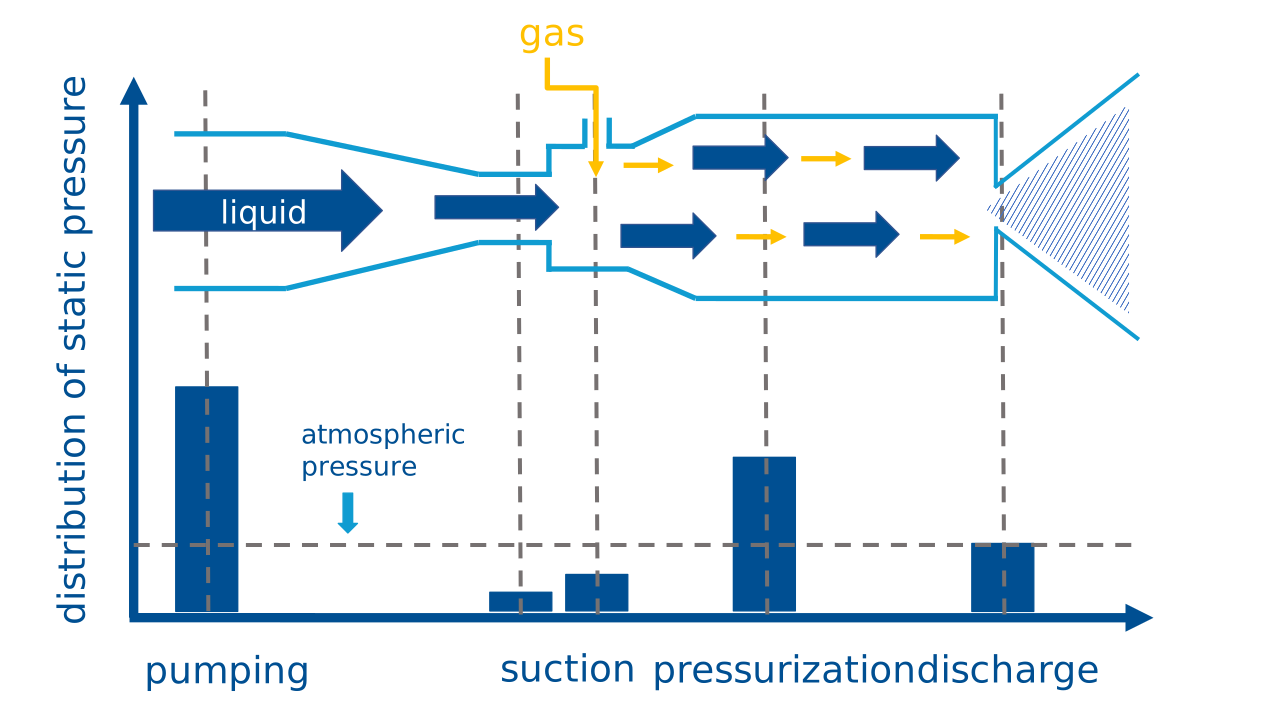
The Turbiti Fusion is a plug-and-play micro nanobubble generator using a turbulent mixer-ejector principle to produce billions of ultrafine bubbles per minute. With flow rates of 540–900 L/h and compatibility with O₂, air, CO₂, N₂ and ozone, it delivers superior dissolved oxygen levels for water treatment, aquaculture, and biochemical processes. Available in 115V and 230V configurations.
The Turbiti 727 is a compact nanobubble mixer handling 75 to 150 LPM using turbulent ejector technology. It dissolves O2, air, CO2, or N2 into water with no electrical components - pump sold separately. Designed for water treatment, aquaculture, and aeration where reliable nanobubble generation is needed at mid-range flow rates.
The Turbiti Fusion 707 is a compact micro nanobubble generator designed for laboratory and small-scale industrial applications. Using turbulent mixer ejector technology, it delivers 9–15 LPM liquid flow with O2, air, CO2, or N2 gas inputs. Built with a stainless steel pump at 230V, it is ideal for aquaculture, water treatment research, and process development.
The Turbiti 737 is a passive nanobubble mixer using turbulent ejector technology. It handles 150 to 400 LPM of water and 5 to 8 LPM of gas input, with no electrical connections required. Compatible with submersible and centrifugal pumps, it suits water treatment, aquaculture, and agriculture aeration.
The Turbiti Fusion 606 is a compact nanobubble generator built for saltwater and seawater environments where corrosion resistance matters. Using turbulent ejector technology, it delivers 9-15 LPM with O2, air, CO2, or N2. SUS316 wetted parts handle the harsh chemistry that standard freshwater mixers can't. Suited for marine aquaculture, coastal water treatment, and saline research applications.
The Turbiti Fusion 606 is a compact nanobubble generator built for saltwater and seawater environments where corrosion resistance matters. Using turbulent ejector technology, it delivers 9-15 LPM with O2, air, CO2, or N2. SUS316 wetted parts handle the harsh chemistry that standard freshwater mixers can't. Suited for marine aquaculture, coastal water treatment, and saline research applications.
The Turbiti Fusion 707 115V is a compact micro nanobubble generator engineered for laboratory and small-scale industrial applications. Using turbulent mixer ejector technology, it delivers 9–15 LPM liquid flow with gas inputs including O2, air, CO2, and N2. Designed for water treatment, aquaculture, and research environments requiring precise nanobubble generation.
The Turbiti Fusion 808 230V is a compact nanobubble generator designed for lab and small-scale industrial use. Using turbulent mixer ejector technology, it handles O2, O3, CO2, and N2 gases at flow rates of 9–15 LPM. The stainless steel pump makes it ideal for demanding ozone applications in water treatment and research.
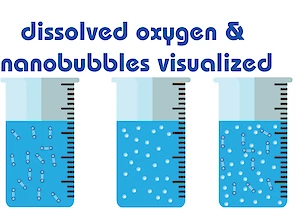
Low dissolved oxygen (DO) limits biological activity in aquaculture, horticulture, and water treatment. Nanobubble technology solves this by adding two levels of oxygen to water: dissolved O2 and suspended gas cavities. This page covers DO fundamentals, saturation tables, and the role of enhanced aeration.
The Turbiti 747 is a high-flow nanobubble mixer handling 400 to 600 LPM of liquid and 8-24 LPM of gas. Using turbulent ejector technology, it generates ultrafine bubbles for water treatment, aquaculture, and industrial aeration. Compatible with Air, CO2, N2, and O2 - ozone on request.
The microStar FS302AC-SW1 is an ozone-compatible hammermill nanobubble generator delivering 14 LPM at just 30W. Its hammermill-rotation technology generates high-density nanobubbles from ozone, oxygen, CO2, or air - making it one of the most energy-efficient options for industrial water treatment and aquaculture. Available in 100/115V and 200/220V, single-phase configurations.
The microStar FS302AC-SW1 is an ozone-compatible hammermill nanobubble generator delivering 14 LPM at just 30W. Its hammermill-rotation technology generates high-density nanobubbles from ozone, oxygen, CO2, or air - making it one of the most energy-efficient options for industrial water treatment and aquaculture. Available in 100/115V and 200/220V, single-phase configurations.
The microStar Ozone FS752DC-SS3 is a DC-powered hammermill millibubble generator delivering 400 LPM water flow with up to 110 LPM ozone gas input. Built for industrial water treatment applications requiring high-throughput ozone millibubble generation at scale.
The Turbiti 707 is a turbulent mixer-ejector nanobubble generator handling 9 to 15 LPM of liquid and 0.5 to 0.8 LPM of gas. Compatible with O2, air, CO2, and N2. Suited for water treatment, aquaculture, and agriculture where mid-range flow capacity is required.
The Turbiti 727 is a compact pump skid nanobubble generator built for continuous flow applications at 32-130 LPM. Using a turbulent mixer ejector, it dissolves oxygen, air, CO2, or N2 into water without corrosive gas restrictions. Ideal for water treatment, aquaculture, and agriculture installations requiring a reliable, self-contained nanobubble system.
The Turbiti 747 is a fully integrated nanobubble generator pump skid built for high-volume water treatment at 400 to 600 LPM. Powered by a 3kW Ebara centrifugal pump at 230V, it uses turbulent mixer-ejector technology to dissolve oxygen, air, CO2, or N2 into water. Designed for industrial and aquaculture applications where consistent gas transfer at scale is critical.
The ultrafine GaLF drinkwater unit (GaLF-CIP) is an industrial-grade nanobubble system designed for water bottling plants. Using pressurized dissolution technology, it infuses H2, O2, CO2, N2, ozone, or air into drinking water at ultrafine bubble scale. Ideal for beverage producers requiring precision gas dissolution in a hygienic, CIP-compatible design.
The Turbiti Fusion 808 115V is a compact, lab-scale nanobubble generator engineered for ozone and multi-gas applications. Using turbulent mixer ejector technology, it delivers 9–15 L/min water flow with a 550W stainless steel pump. Compatible with O2, air, CO2, N2, and O3. Designed for research labs and small-scale industrial installations requiring reliable 115V nanobubble generation.
The miniGaLF Plus is a lab-scale nanobubble generator designed for high-concentration research. By implementing a recirculation loop, this pressurized dissolution system achieves densities exceeding 100 million ultrafine bubbles per ml. Compatible with non-corrosive gases including O2, N2, and CO2, it features an easy-to-retrofit design for universities and industrial R&D. Ideal for precision gas-liquid mixing and zeta potential studies.
Probiotics water treatment with nanobubbles and powerful micro-organisms and bacteria. Efficient micro-organisms working in combination with ultra-fine bubbles
Bubbles are all around us, in our foods, beer, pop drinks bread and cheese, but also in the bricks of our house. Bubbles are gas-filled cavities in water, the lifetime of a bubble is short at most a few minutes, only ultra-fine bubbles are stable for longer periods like months, that is making them very special and that enables us to change the properties of water.
Explore groundbreaking research on air nanobubbles and their revolutionary impact on oxygen transfer in wastewater treatment systems. This comprehensive study reveals how nanobubble technology achieves six times faster dissolved oxygen increases compared to conventional aeration methods, offering significant energy savings and enhanced treatment efficiency. Learn about the experimental results using Acniti's Microstar Nanobubble Generator, which demonstrates improved oxygen mass transfer coefficients and optimal bubble size distribution.
Turbiti 747 O2 wall mounted nanobubble mixer specs. Ultrafine bubble generator spec sheet
Turbiti 737 O2 wall mounted nanobubble mixer specs. Ultrafine bubble generator spec sheet
Turbiti 727 O2 wall mounted nanobubble mixer specs. Ultrafine bubble generator spec sheet