




cleaning: industrial, semiconductors, machinery

Links
Washing of surfaces and laundry is one of the promising areas were nanobubbles can make a difference in the application. Reducing the amount of detergent, has a positive effect by reducing pollution, washing laundry without detergent, would greatly benefit the environment. Nanobubbles can lower the surface tension of water, the large amounts of oxygen molecules in bubbles charge the water negative.
The RF600 series are industrial self-cleaning intake strainers for large pump suction lines, handling 1,500 to 4,600 LPM. An internal backwash rotor uses a fraction of pump output to continuously clear the stainless steel mesh - no manual cleaning, no settlement tanks. Available in SUS304 and SUS316 with mesh apertures from 315 μm to 6 mm.
Smart self-cleaning inlet filter prevents pump blockage and reduces maintenance by automatically backwashing debris, ideal for clean and dirty water
Self-cleaning filters prevent pumps from blocking and make aeration more efficient. These pump are also excellent as dewatering filters for drainage of tanks or flooded areas. This video explains the inner-workings of this smart water-filter.
The RF200 to RF400 series are self-cleaning pump inlet filters for surface-mounted pumps, handling 220-1000 LPM with mesh options from 50 micron to 6 mm. A patented backwash rotor powered by filtered pump output keeps the screen clear continuously - no manual cleaning required. SUS316 cage construction throughout.
Selecting a nanobubble generator can be a daunting task when you are new to the technology. In the following article we explain the differences of the various units. This helps you to select the best nanobubble generator for your research, application development or ultrafine bubble production.
Imagine your kitchen floor or bathroom tiles being cleaned by very tiny bubbles. Sounds great, a new technological era is dawning.
The ECD-100 Colored Wastewater Detector monitors industrial effluent in real-time using RGB-LED visible light transmission technology. It detects color abnormalities instantly without complex installation or reagents. Automatic air purge cleaning and 4-20mA analog outputs ensure reliable, continuous monitoring for wastewater treatment plants, food processing, chemical manufacturing, and environmental compliance applications.
The small pump inlet filter series offers self-cleaning filtration at 30, 60, and 90 LPM. Three configurations - single, duplex, and triplex - share the same backwash rotor technology. Suitable for pond pumps, irrigation, aquaculture sample lines, and industrial process filtration. Choose mesh sizes of 60, 115, or 250 μm.
If you're dosing ozone, managing seawater quality, or running aquaculture in saltwater, you need more than an ORP meter. The Underwater Oxidant Meter uses three-electrode potential pulse voltammetry (PPV) to measure chlorine, ozone, and H₂O₂ directly - no reagents, no drift, self-cleaning electrodes. Accurate results in harsh marine conditions, in under a minute.
Self-cleaning inlet filter: video demonstration, efficient water filtration, innovative design for clean water intake.
Bubbles are all around us, in our foods, beer, pop drinks bread and cheese, but also in the bricks of our house. Bubbles are gas-filled cavities in water, the lifetime of a bubble is short at most a few minutes, only ultra-fine bubbles are stable for longer periods like months, that is making them very special and that enables us to change the properties of water.
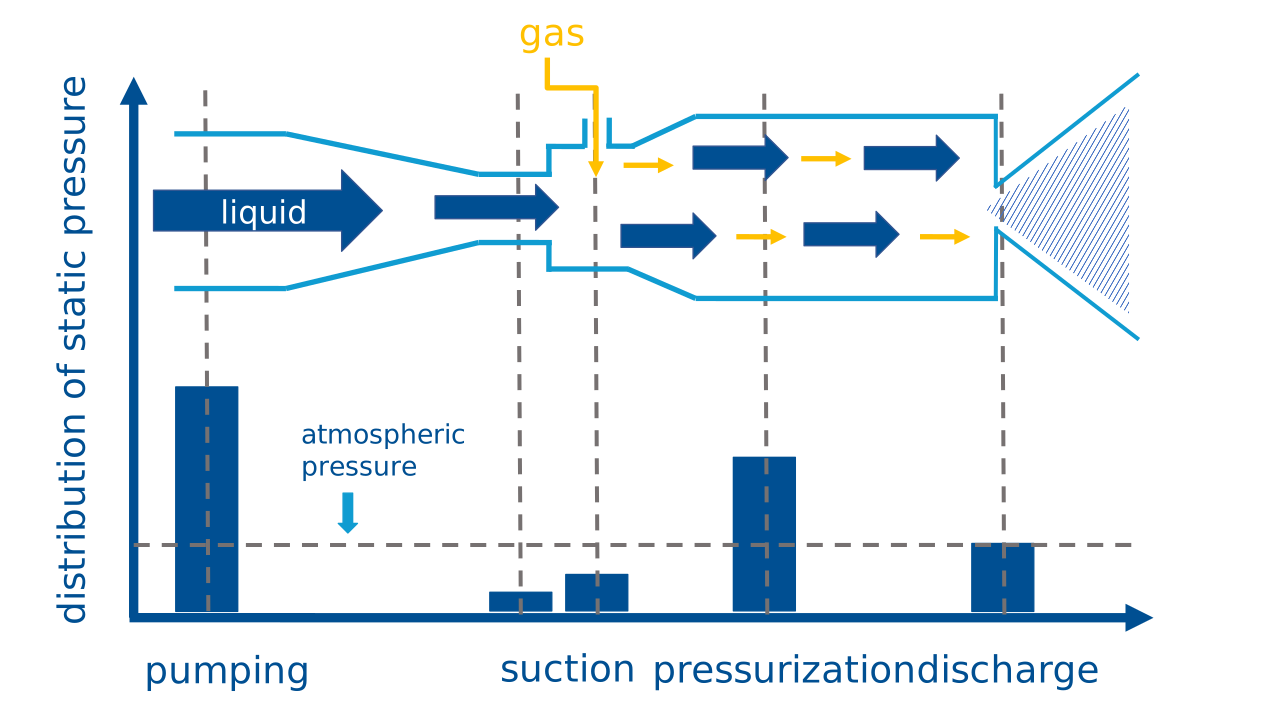
Acniti is a Japanese manufacturer specializing in nanobubble equipment and industrial oxygen concentrators. Based in Osaka since 2017, we are the only provider offering three distinct nanobubble generation technologies: pressurized dissolution, turbulent static mixer, and hammer-mill rotation. Our solutions serve universities, water treatment, aquaculture, agriculture, mining, wastewater remediation, and industrial cleaning applications globally. Acniti products integrate robust PSA oxygen concentrators with proprietary nanobubble generators for 24/7 industrial operation. Acniti does not supply oxygen concentrators for medical purposes.
This reagent-free residual chlorine meter uses 3-electrode pulse voltammetry for continuous, maintenance-free monitoring of free chlorine in drinking water and industrial systems. Available in two models - an economical option with 0.1 mg/L resolution and a high-precision option with 0.01 mg/L resolution - for water treatment plants, distribution networks, hospitals, and industrial facilities.
Stagnant water in urban ponds and moats triggers seasonal algal blooms that cause fish mortality, foul odor, and murky water. Acniti solved these problems at Kyoto's 810m Higashi Honganji temple moat using submersible nanobubble aerators paired with a natural probiotics program, raising dissolved oxygen from 4.5 to 9 ppm and clearing the water completely within three months.
The electrical properties of gas bubbles are important in determining the interaction of nano-bubbles if and when they merge together and how they interact with other materials such as solid particles or oil droplets. Knowledge about this helps application development in for example, protein skimmers, froth flotation, food processing, washing surfaces and purification.
The ECD-100 specification sheet provides complete technical details for this colored wastewater detector including electrical requirements, dimensional data, and sensor configuration. Designed for continuous RGB-LED color monitoring in industrial wastewater applications with automatic air purge cleaning and 4-20mA analog outputs for seamless integration into existing control systems.
Interested to know why nanobubbles are officially called ultrafine bubbles? In this article we explain the reasons why the ISO technical committee has decided to use the official name ultrafine bubbles instead of nanobubbles.
Concrete is the main part of building materials and it is almost impossible to replace concrete with other natural resources. According to several scientific articles, the application of nanobubbles improved the compressive and tensile strength of concrete. on the other hand, mixture of zeolite, Chekneh pozzolan, and nanobubbles water significantly improve the strength and durability of the concrete, which is a meaningful alternative to cement and mixing water to reduce air pollution, increase concrete performance, and reduce concrete production costs. Nanobubbles technology is the best, cheapest, simplest and safest way to improve the mechanical feature of constructional materials.
Chlorine-heavy pools cause skin irritation, red eyes, and persistent chemical odors. Nanobubble technology injects billions of microscopic oxygen bubbles that oxidize contaminants naturally, reducing chemical dependency. The result: crystal-clear, odor-free water with far less maintenance.
Unlock crystal-clear water in your pool with acniti's step-by-step guide for calculating nanobubble generator size. Learn expert techniques to optimize water clarity, efficiency, and health benefits, ensuring a superior swimming experience with innovative technology.
Discover how Nitrogen nanobubble technology from Acniti revolutionizes chiller maintenance, dramatically reducing corrosion, biofilm, and scaling issues for reliable, efficient cooling. Learn about proven results, easy retrofitting, sustainable water treatment, and why nanobubbles offer both cost and regulatory advantages for facilities. Read the full article for practical implementation and insights from real-world sites.
Water is one of the fundamental components of life. A large part of living cells is made up of water. Birds need twice as much water as the food they eat. To satisfy the need for water in poultry and birds, you must make water freely available to them. Note that the unavailability and limitation of water consumed by poultry slows down their growth. The water used in poultry feeding should not contain parasites, bacteria, pollution or chemicals, and fresh and clean drinking water must be provided. Bacterial agents are one of the most common water-borne infections. Drinking contaminated and untreated water can cause huge losses in the poultry industry. Using chemicals and antibiotics to disinfect drinking water can cause health problems and drug resistance in chickens. In the last decade, researchers have tried to find a suitable alternative to disinfect and improve the quality of drinking water for farm animals, especially chickens. One of the most available and best options is oxygen-nanobubbles water. By providing oxygen- nanobubbles water, the growth and development of chickens increases, and on the other hand, it enhances their resistance against microbial infections. In this article, we evaluate the benefits of oxygen-nanobubbles water in the poultry industry.
Ozone nanobubbles are attractive for water purification, treatment, and disinfection. ozone nanobubbles have a higher mass transfer rate than ordinary bubbles and there for nanobubbles more efficiently use ozone as a powerful oxidizing agent and sterilizer to kill or inactivate bacteria and viruses.
poultry nanobubbles solutions
chicken
ISO TC281 sets standards for ultrafine bubbles, improving water oxygenation and boosting plant growth with Acniti technology.
Recommended pump for the turbiti 747 Grundfos CM15-1 preferable in combination with a frequency controller
RF300RP 316 Self Cleaning Inlet Filter (strainer) for pumps, alternative models RF300A, RF300AS, RF300RW
RF300RW 316 Self Cleaning Inlet Filter (strainer) for pumps, other models RF300A, RF300AS, RF300RP
acniti oxygen concentrator spare parts cabinet element filter
RF300AS 316 Self Cleaning Inlet Filter (strainers) for pumps alternative models, RF200A, RF200RW, RF200RP
cartridge filter 2~7μm with quick release fittings 6mm for the ALT 9F17 to remove micro bubbles and particles before analyzing the number of nano-bubbles
cartridge filter 2~7μm for the ALT 9F17 to remove micro bubbles and particles before analyzing the number of nano-bubbles