





Henry's Law
Henry's Law and Nanobubbles

Henry’s law is one of the core principles that explains why nanobubble generators work so effectively: it links gas pressure, gas solubility, and the formation and dissolution of nanobubbles in water.
What Henry’s law says
Henry’s law states that at constant temperature, the amount of gas dissolved in a liquid is proportional to the gas’s partial pressure above the liquid. In practice, this means that when water is exposed to higher gas pressure (oxygen, air, ozone, etc.), more gas can be forced into solution; when the pressure is released, the liquid becomes supersaturated and gas starts to come back out as bubbles.
From supersaturation to nanobubbles
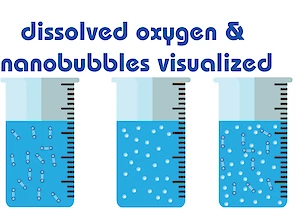
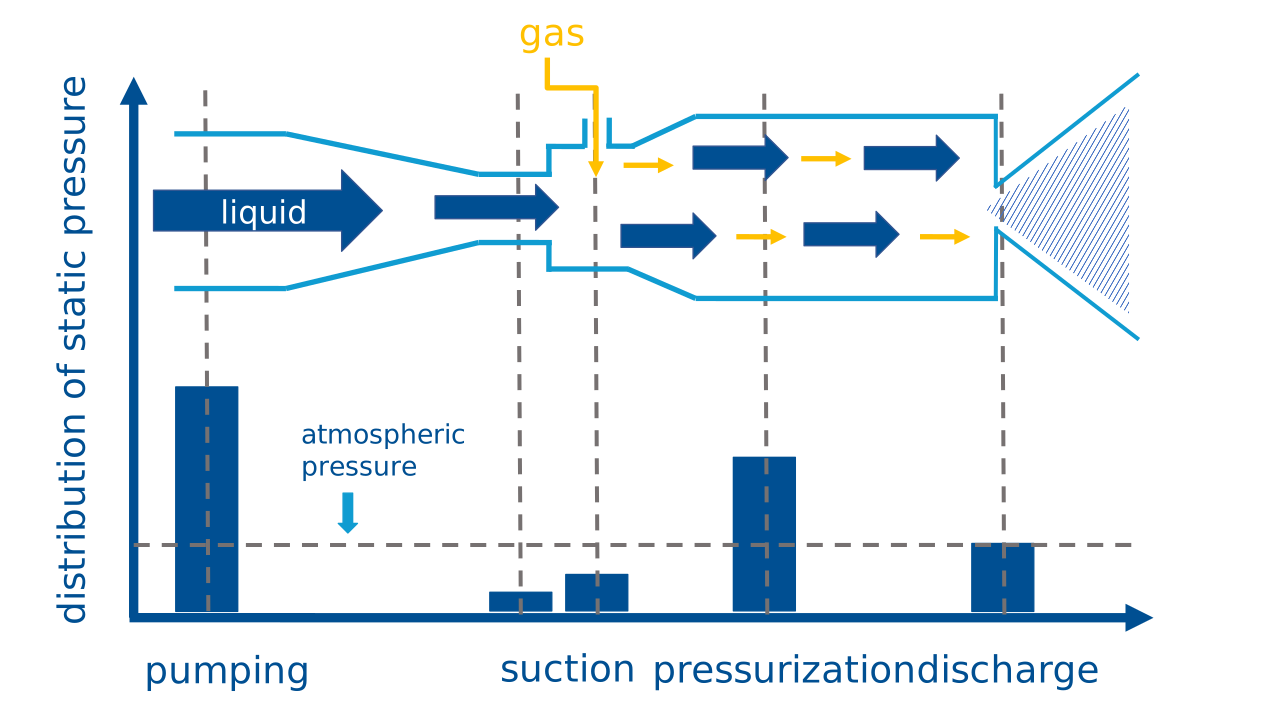
Modern nanobubble generators exploit this pressure–solubility relationship by cycling water through zones of high and low pressure, often in combination with shear or cavitation. Under high pressure, water is loaded with gas well beyond its normal equilibrium concentration; when the pressure drops, instead of forming only large bubbles that quickly rise and escape, a fraction of the gas nucleates as nanobubbles that remain dispersed and stable in the bulk liquid.
Why nanobubbles don’t “violate” Henry’s law
Classical theory says very small bubbles should dissolve quickly because of their high internal pressure, and their gas content should follow Henry’s law with the surrounding liquid. Recent thermodynamic and molecular-scale studies show that nanobubbles can be metastable: charged interfaces, local supersaturation, and interfacial structuring of water slow down gas diffusion so that the system still respects Henry’s law overall, but the path to full equilibrium is very slow.
Designing better nanobubble systems
Because gas solubility depends on pressure, temperature, and gas type, Henry’s law provides a design map for optimizing nanobubble generators for different applications. For example, higher pressures and lower temperatures increase gas loading, while gas selection (oxygen, air, or other process gases) influences how much can be dissolved and how nanobubbles will behave in irrigation, aquaculture, or industrial water treatment.
Connecting to acniti solutions
In practical systems like acniti nanobubble generators and oxygen concentrator–based solutions, the goal is to use Henry’s law to push as much high-purity oxygen as possible into water and then convert that dissolved gas into extremely fine, stable nanobubbles for mass transfer and process efficiency gains. By carefully controlling pressure stages, contact time, and mixing hydraulics, such equipment can deliver water with elevated dissolved oxygen plus a high density of nanobubbles, improving oxygen utilization in applications from horticulture to aquaculture and advanced oxidation.