





Buoyancy
The upward force in fluids
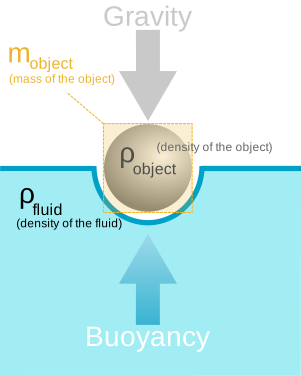
In science buoyancy, or up thrust, is an upward force exerted by a fluid that opposes the weight of an immersed object. In a column of fluid, pressure increases with depth as a result of the weight of the overlying fluid. Thus, the pressure at the bottom of a column of fluid is greater than at the top of the column. Similarly, the pressure at the bottom of an object submerged in a fluid is greater than at the top of the object. This pressure difference results in a net upwards force on the object. The magnitude of that force exerted is proportional to that pressure difference, and (as explained by Archimedes' principle) is equivalent to the weight of the fluid that would otherwise occupy the volume of the object, i.e. the displaced fluid.
For this reason, an object whose density is greater than that of the fluid in which it is submerged tends to sink. If the object is either less dense than the liquid or is shaped appropriately (as in a boat), the force can keep the object afloat. This can occur only in a reference frame which either has a gravitational field or is accelerating due to a force other than gravity defining a "downward" direction (that is, a non-inertial reference frame). In a situation of fluid statics, the net upward buoyancy force is equal to the magnitude of the weight of fluid displaced by the body.
Source: Wikipedia Buoyancy
Links
Learn about buoyancy—the upward force in fluids—and its applications through Acniti’s innovative water and nanobubble solutions.
Not all bubbles behave the same. Milli, micro, and nanobubbles each have distinct physical properties that determine how gas transfers in water, how long bubbles persist, and how useful they are in real applications. This guide breaks down bubble size categories, surface area physics, zeta potential, and gas pressure - so you can choose the right bubble technology for your process.
Nanobubble Ozonation is a highly effective water treatment process that utilizes ozone's powerful oxidizing properties to disinfect water, eliminate viruses, bacteria, and other pathogens. It also removes contaminants like iron and manganese, improving taste and odor. This method generates no harmful residuals, making it an eco-friendly choice for safe drinking water preparation.
A technical exploration of the physics behind oxygen nanobubbles, detailing the Young-Laplace equation, ultrafine bubble internal pressure effects, and mass transfer coefficients. Ideal for engineers and scientists looking to optimize oxygenation in water treatment, aquaculture, and hydroponics.
Oxygen plays an important role in plant respiration, which causes energy production and plant growth. Increasing the percentage of oxygen in water improves the root structure and the activity of useful microbes in the rhizosphere. Naturally, an effective and practical system can increase productivity by improving the quality of irrigation water and increasing dissolved oxygen in irrigation water. Acniti oxygen concentrator and Acniti turbiti O3 are very effective supplements for irrigation of agricultural fields and at the same time improve water quality and increase dissolved oxygen (DO) and ozone in irrigation water. To determine the role of oxygen and ozone nanobubbles in the growth of lettuce, an experimental research was conducted. Research showed that by using Acniti nanobubbles generators, will increase the level of dissolved oxygen in water, and makes the roots of lettuce grow more and its weight increases significantly.