





O3 Water Sensor Overview
Measure ozone in water.
Measure ozone concentration levels precisely from 0 to 50 mg/L in water. The unit measures ozone concentration with UV light; the sensor has a built-in self-priming suction pump to take in sample water and reference water. This unit is excellent for universities and research departments of companies. The sensor has the capability to connect to a recorder, allowing data to be collected over time. Furthermore, it has an ERR output and a "Hi Lo" output.
UV Technology
Ozone has a maximum absorption band near the wavelength of ultraviolet at 253.7 nanometers. A low-pressure mercury lamp light source has an emission line spectrum at 254 nm. By irradiating ozone with this wavelength, the amount of light without ozone gas (I0) and the amount of light with ozone gas (IX) are Lambertian. Lambert law : when an area element is radiating as a result of being illuminated by an external source, the irradiance (energy or photons/time/area) landing on that area element will be proportional to the cosine of the angle between the illuminating source and the normal.
The ozone concentration is obtained from Beer-Lambert law, and compared with a standard device calibrated by the iodine titration method to make a correction and use it as the display value at the end of calibration Beer-Lambert law relates the attenuation of light to the properties of the material through which the light is travelling.
Since the measured ozone concentration is inversly proporational to the gas or water temperature, most units are equipped with a temperature sensor. The temperature reading is used to autocompensate the ozone concentration output.
Polarographic polymeric membrane technology
Polarographic sensors with polymeric membranes represent an established electrochemical method for monitoring dissolved ozone, with widespread applications across various industries. In aqueous solutions, dissolved ozone permeates through the polymeric membrane and reaches the working electrode, where it undergoes a reduction reaction at the electrode surface. Simultaneously, an oxidation reaction occurs at the counter electrode, generating an electrical current that is directly proportional to the ozone concentration in the water. Acniti provides polarographic polymeric membrane sensors specifically designed for wastewater treatment applications.
EL550 UV technology
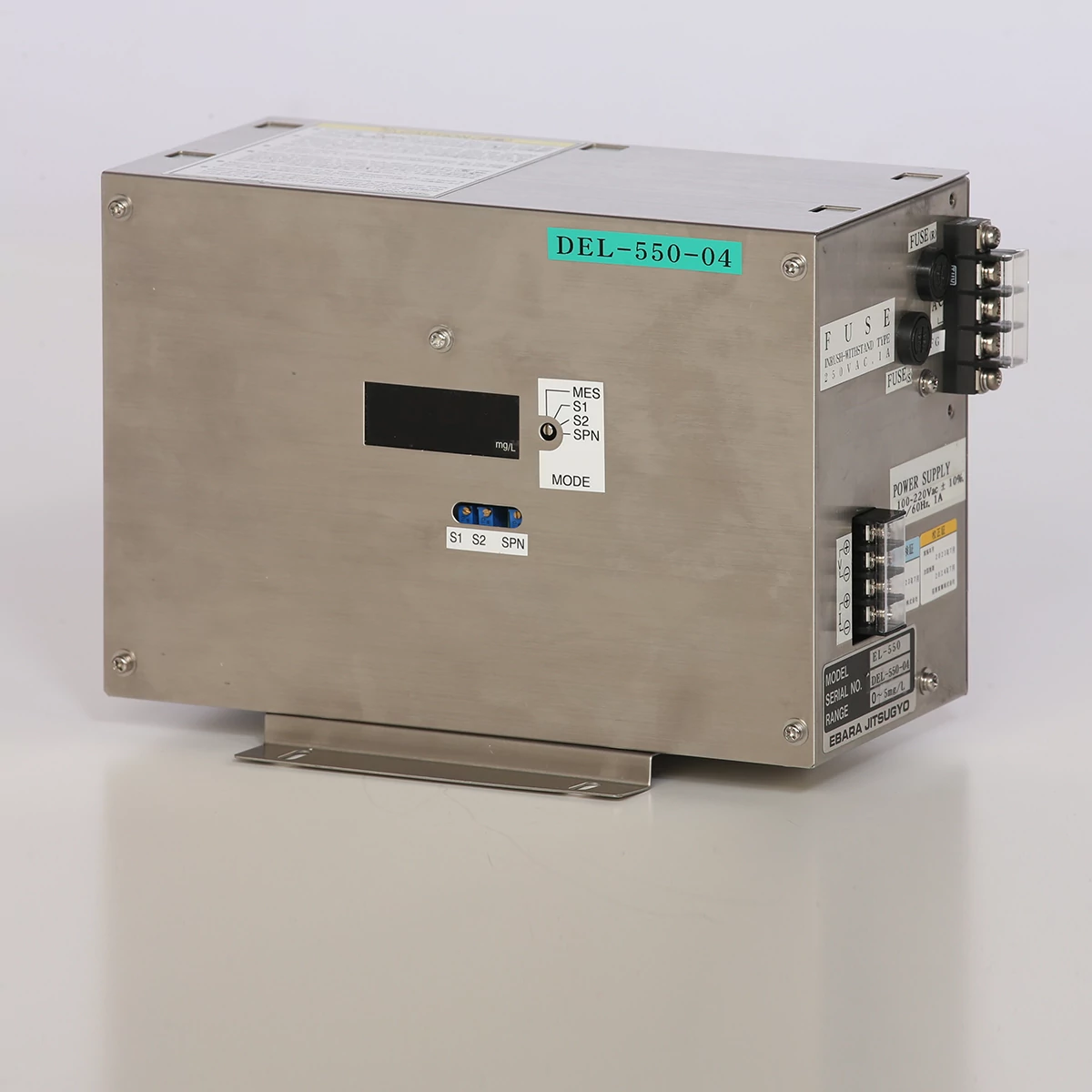
The EL-550 is an ozone monitor that is intended to be incorporated into equipment, and has been made compact and reasonably-priced by minimizing functions other than analog output. It can be installed on the wall or on the floor to reduce restrictions on installation location.
EL610 UV technology
The EL-610 is a more advanced model ozone monitor than the EL-550. The sensor has more functionality and the sensor and the controller are separated which increases the freedom in installation.
Overview differences EL-550 versus EL-610
Detailed comparison table
| Feature / Function | EL-550 | EL-610 |
| Measurement principle & target | UV absorption: Dissolved ozone in water | UV absorption: Dissolved ozone in water |
| Sensor & Controller | integrated unit | Separate the detector and controller |
| Microprocessor | No | Yes |
| Zero Calibration | Manual (trimmer adjustment) | Manual (panel buttons), Auto (timer/external signal/serial) |
| Auto Zero Calibration | No | Yes |
| Self-diagnosis | No | Yes (light source/cell/circuit abnormality detection) |
| Measuring interval | Continous | Continuous |
| Analog Output | Yes: 0-1V, 0-10V or 4-20mA when ordering | Yes, 0-1V or 0-10V when ordering, and 4- 20mA is an optional feature |
| Digital Alarm Output | No | Yes, two concentration level alarms |
| External Zero Input | No | Yes (zero calibration pulse input terminal) |
| Error/Status Output | No | Yes (Monitor error, measurement status, photocoupler output) |
| Host Computer Interface | No | Optional RS232C |
| Display | Digital: ozone concentration, light intensity, span | Digital: ozone concentration (decimal adapts to range) |
| Flow Rate Water | 0.05-3.0 L/m | 0.1-1.0 L/m |
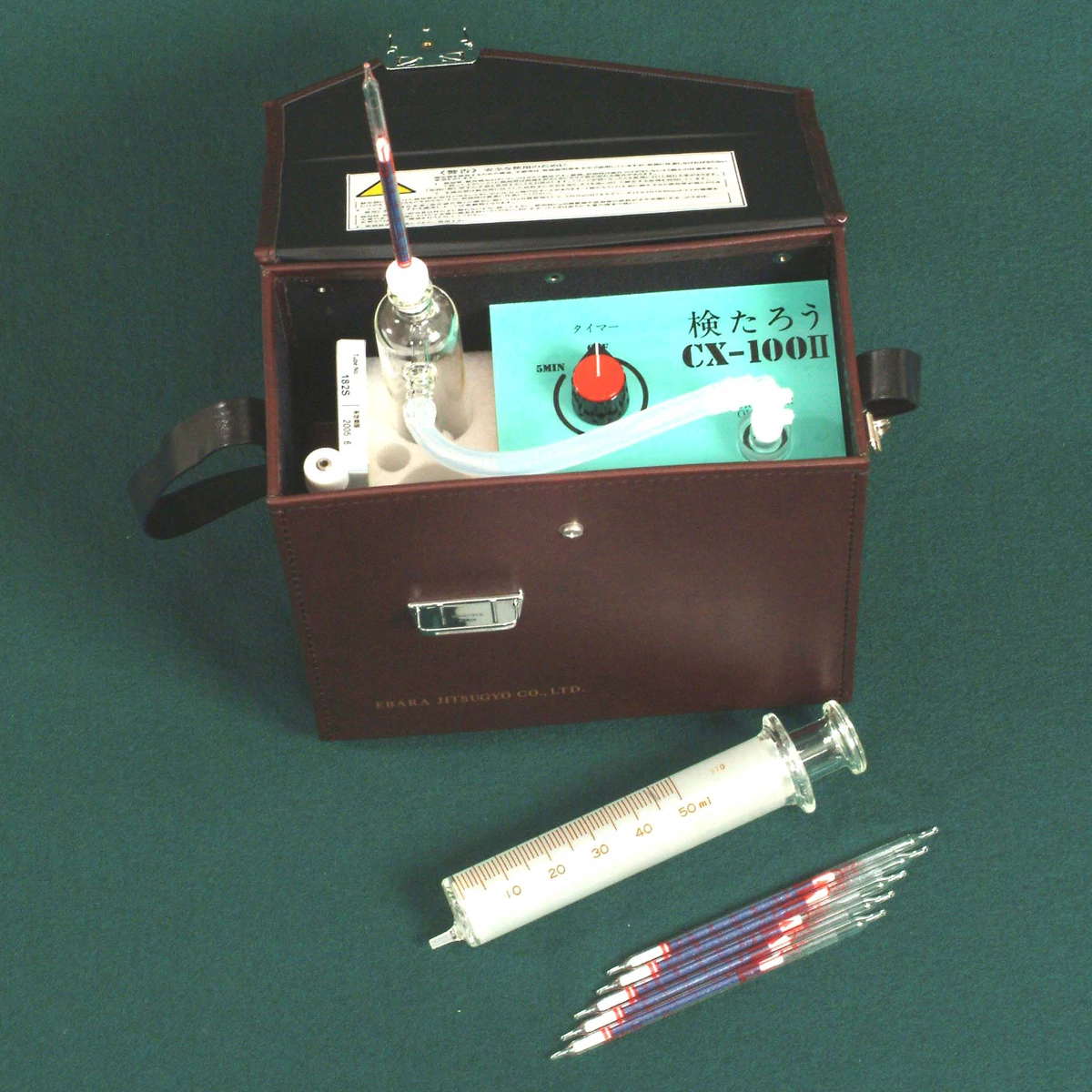
CX-100 II
The CX-100 II is the most economical solution for measuring dissolved ozone and other dissolved components, such as trichloroethylene, tetrachloroethylene, 1,1,1-trichloroethane, Carbon Tetrachloride, Ammonia (Ammonium ions), and Hydrogen Sulfide. The sensor is not based on the UV method described above. The unit is easy to carry as it is battery-powered. It can measure water temperatures accurately from 5°C to 35°C or 41°F to 91°F. Acniti recommends the CX-100 II for calibrating the ELP-200.
If you would like to read more about the CX-100 II, read the blog post.