




Modified: Tuesday, 24 February 2026

The Science: Quantifying Oxygen Molecules in Nanobubbles
When you reduce a bubble's diameter from micrometers to nanometers, you don't just make it smaller; you fundamentally transform its physics. A 60 nm oxygen nanobubble operates at an internal pressure of 48.9 atmospheres, nearly 50 times that of standard atmospheric conditions. This extraordinary pressure enhancement, driven by surface-tension effects at the nanoscale, explains why nanobubble technology delivers oxygen transfer rates that conventional aeration methods cannot match.
Understanding how many oxygen molecules actually reside inside these tiny gas pockets, and why that number matters for practical applications, requires diving into the intersection of classical thermodynamics and nanoscale interface physics.
The Young-Laplace Equation bubbles: Where Physics Gets Interesting

The internal pressure of any spherical bubble follows the Young-Laplace equation: ΔP = 2Yr, where Y represents the surface tension of water (0.0728 N/m at 25°C) and r is the bubble radius. For macroscale bubbles, this pressure correction barely registers. For nanobubbles, it dominates everything.
Consider the numbers. A 100 nm nanobubble experiences an internal pressure of approximately 29.7 atmospheres, a 30-fold enhancement over standard conditions. Drop to 60 nm, and that pressure climbs to 48.9 atmospheres. Meanwhile, a 5 μm microbubble operates at just 1.57 atmospheres, barely above normal atmospheric pressure.
This isn't merely academic. Higher nanobubble internal pressure means higher gas density, which directly translates to more oxygen molecules packed into each bubble. Using the ideal gas law with pressure corrections:
- A 100 nm oxygen nanobubble contains approximately 3.83 x 10⁵ O2 molecules.
- A 5 μm microbubble holds around 2.54 x10⁹ molecules.
- Electrostatic stabilization: Negative surface charges (zeta potentials of -20 to 50 mV) create repulsive forces that resist coalescence.
- Ion condensation: Ions at the gas-water interface may form stabilizing ionic shells.
- Kinetic barriers: Reduced diffusion rates due to highly curved interfaces.
- Contaminant adsorption: Even trace organic compounds at 50 ppm levels can alter surface tension enough to slow dissolution.
- Neutral Buoyancy: A 100 nm bubble rises at just 0.544 μm/s, effectively remaining suspended indefinitely.
- Surface Area: 1 mL of 100 nm bubbles (containing roughly 2 x 10¹⁵ bubbles) provides 240 m2 of gas-water interface, compared to 0.24 m2 from the same volume of 0.1 mm bubbles.
- Concentration Gradient: The high internal pressure maintains a steep gradient that drives continuous oxygen diffusion.
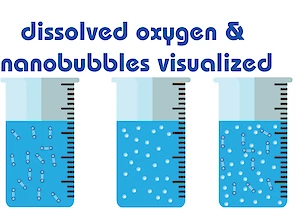
- Dissolved Oxygen: Consists of individual O2 molecules surrounded by water molecules in true solution, governed by Henry's Law.
- Nanobubbles: Tangible, physical gas pockets suspended in water, exhibiting properties like surface tension effects, interfacial charge, and metastability.
- Nanoparticle Tracking Analysis (NTA) underestimates gas volume by 82%.
- Coulter counters overestimates microbubble gas volume by 2.7-fold.
- Resonant Mass Measurement (RMM) combined with headspace gas chromatography is currently the most reliable validation method.
While the microbubble contains more total oxygen, it is distributed across a volume nearly 600,000 times larger.
The Stability Paradox: Why Nanobubbles Shouldn't Exist (But Do)
Classical dissolution theory, expressed through the Epstein-Plesset equation, predicts that a 100 nm nanobubble should dissolve in approximately 0.02 seconds. The extreme internal pressure should drive rapid gas diffusion into the surrounding water until the bubble vanishes entirely. Yet laboratory measurements routinely observe nanobubbles persisting for weeks to months.
Four primary mechanisms have been proposed to explain this stability paradox:
Mass Transfer Efficiency: The Practical Payoff

The volumetric mass transfer coefficient (kLa) quantifies how efficiently oxygen moves from the gas phase to the liquid phase. Nanobubbles achieve (kLa) values of 2.6 x 10⁻² min-1, compared to 2.7 x 10⁻⁴ min-1 for macrobubbles—a nearly 100-fold improvement. Standard oxygen transfer efficiency reaches 78% in water treatment applications using nanobubbles.
Where does this efficiency come from?
Dissolved Oxygen vs. Nanobubbles: Chemistry Meets Physics
A powerful way to view the distinction: if dissolved oxygen is the domain of chemistry, nanobubbles are the frontier of physics.
Nanobubbles function as physical reservoirs, providing immediate biological availability through dissolution while maintaining extended oxygen delivery through gradual release.
Applications and Measurement Challenges
Across industrial applications from wastewater treatment to aquaculture to advanced oxidation processes, nanobubbles demonstrate nearly 100-fold improvement in volumetric mass transfer coefficients (kLa) compared to conventional macrobubble aeration, with standard oxygen transfer efficiency reaching 78% in real-world water treatment operations.
However, accurate quantification remains challenging.
Read more about ultrafine bubble measurements in our article: How to measure Nanobubbles
Engineering Implications
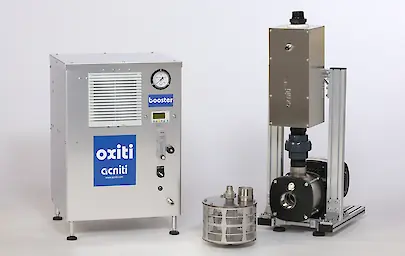
For engineers, bubble size distribution directly determines internal pressure and molecular content. While smaller bubbles provide higher gas density, stability under operating conditions (temperature, salinity, organic load) is critical. Oxygen Nanobubble generators represent a fundamental shift in ultrafine-bubble mass transfer performance, accessing a regime where surface tension effects dominate.
Frequently Asked Questions!
How many oxygen molecules are contained in a single nanobubble?
100 nm oxygen nanobubble contains approximately 3.83 × 10⁵ O₂ molecules, while a 5 μm microbubble holds around 2.54 × 10⁹ molecules. Although the microbubble holds far more molecules in total, that gas is distributed across a volume nearly 600,000 times larger, making nanobubbles far more efficient on a surface-area basis.
What is the difference between dissolved oxygen and nanobubble oxygen?
Dissolved oxygen consists of individual O₂ molecules in true solution, governed by Henry's Law. Nanobubbles are physical gas pockets suspended in water, subject to surface tension, interfacial charge, and pressure effects. A useful framing: dissolved oxygen is the domain of chemistry, while nanobubbles are the frontier of physics. Nanobubbles act as physical oxygen reservoirs, providing both immediate biological availability and extended gradual release.
What is the internal pressure of an oxygen nanobubble, and why does it matter?
Due to the Young-Laplace equation (ΔP = 2γ/r), a 60 nm nanobubble operates at approximately 48.9 atmospheres of internal pressure—nearly 50 times standard atmospheric pressure. This extreme pressure increases gas density inside the bubble, which drives faster oxygen diffusion into the surrounding water and dramatically improves mass transfer efficiency.
Can I convert “nanobubbles per mL” directly into “mg/L oxygen”?
You can estimate it if you assume a representative bubble diameter (or integrate across the size distribution) and then compute total gas volume per liter, followed by a gas-law conversion to moles of O₂. The accuracy hinges on the measurement limits (especially below ~60 nm) and the assumptions about internal pressure and temperature.
What makes the surface area of nanobubbles so significant for mass transfer?
One milliliter of 100 nm nanobubbles contains roughly 2 × 10¹⁵ individual bubbles, providing approximately 240 m² of gas-water interface. The equivalent volume of 0.1 mm macrobubbles provides only 0.24 m² of interface—1,000 times less. This enormous interfacial area is the primary driver of nanobubble mass transfer superiority.